


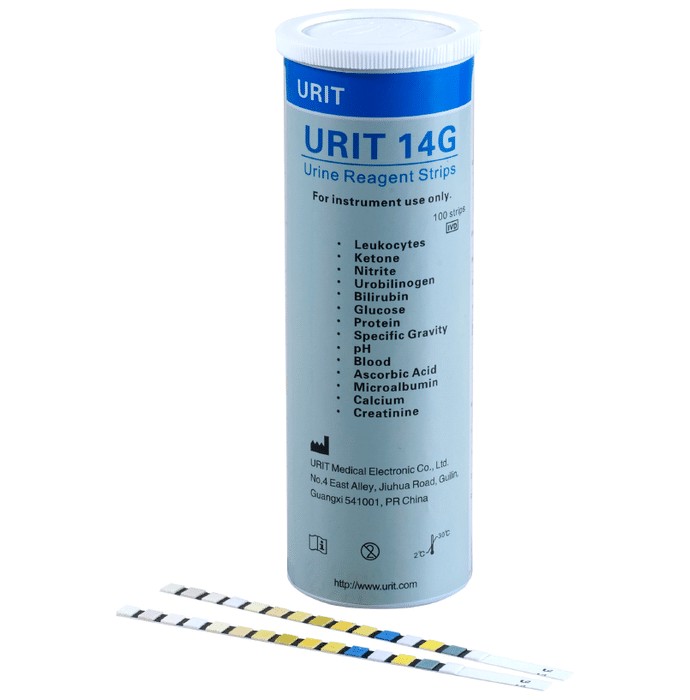
URIT 14G Urine Reagent Strips
Accurex Biomedical Pvt. Ltd
Product highlights
- Analyzes bilirubin, glucose, protein, specific gravity, pH, and blood levels.
- Simple and safe for application.
- Compact, efficient instrument
Overview URIT 14G Urine Reagent Strips
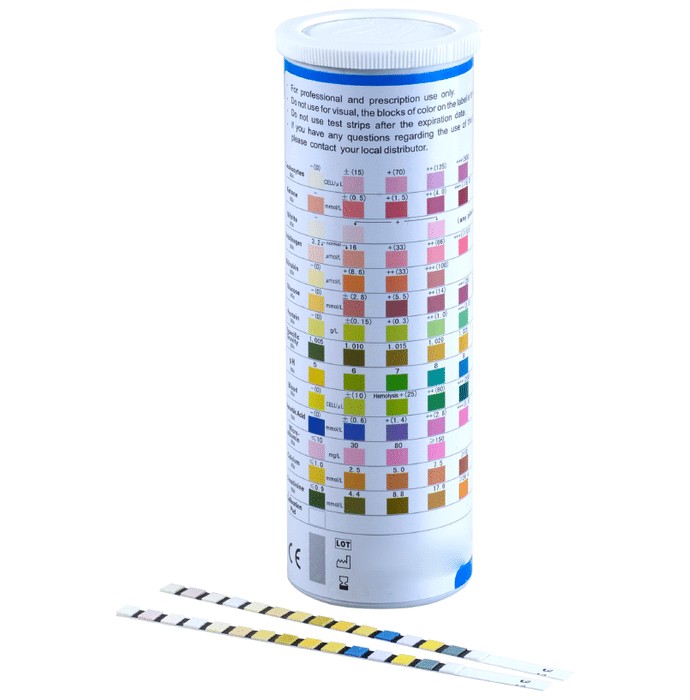
URIT 14G urine reagent strips offer semi-quantitative analysis of urinary leukocytes, ketones, nitrites, urobilinogen, bilirubin, glucose, protein, specific gravity, pH, blood, ascorbic acid, microalbumin, calcium, and creatinine. Compatible with URIT-50, 180, 500B, 500C, 330, 31, and 560 urine analyzers, these strips feature a reagent-coated plastic strip and a reagent-free calibration pad. This design enables multi-analyte urine testing for routine diagnostics and population screening, with the calibration pad automatically compensating for urine's natural color variations, ensuring precise results. Applications include the quantification of the aforementioned urinary components. **Product Specifications and Performance Characteristics:** * **Leukocytes:** Detects granulocyte esterases via an indoxyl ester cleavage reaction, yielding a violet dye. Lysis of leukocytes may yield positive results without visible cells. Vaginal discharge contamination can cause false positives in female samples. High glucose (≥55mmol/L) or specific gravity may reduce readings. Cephalexin, cephalothin, and tetracycline can diminish reactivity, potentially leading to false negatives. Lymphocytes are not detected. Temperature influences reactivity. * **Ketones:** Based on Legal's test, showing greater sensitivity to acetoacetic acid than acetone; β-hydroxybutyric acid is not detected. High specific gravity/low pH urine may yield trace reactions. Highly pigmented urine or urine with substantial levodopa metabolites may produce false positives (Trace). * **Nitrites:** Employs Griess's test, specific to nitrite. Any pink coloration indicates a positive result, suggesting ≥10⁵ organisms/mL, though color intensity doesn't correlate with bacterial count. Negative results don't exclude significant bacteriuria. False negatives can arise from organisms lacking nitrate reductase, insufficient bladder retention (<8 hours), or dietary nitrate deficiency. Ascorbic acid ≥1.4mmol/L can cause false negatives at nitrite concentrations ≤43µmol/L. * **Urobilinogen:** Uses the Ehrlich reaction, detecting concentrations as low as 3µmol/L (≈0.2 Ehrlich unit/dL). Interference from Ehrlich's reagent-reactive substances is possible. Red-colored pigments and medications may cause false positives. Formaldehyde inhibits the reaction. Optimal temperature: 22-26°C. Absence of urobilinogen cannot be definitively determined. * **Bilirubin:** Relies on diazonium salt coupling in an acidic environment. Even trace amounts warrant further investigation. Certain urinary constituents may cause color interference. Ascorbic acid ≥1.4mmol/L may produce false negatives. * **Glucose:** Based on the glucose oxidase/peroxidase reaction; specific to glucose. Ascorbic acid >1.4mmol/L and/or high ketone levels (8mmol/L) may cause false negatives at low glucose (5.5mmol/L). Increasing urine specific gravity reduces reactivity. Hypochlorite or peroxide may cause false positives. Temperature affects reactivity. * **Protein:** Utilizes the protein error of indicators, showing greater sensitivity to albumin. High pH (up to 9) may affect results. Quaternary ammonium or chlorhexidine disinfectant residues may yield false positives. * **Specific Gravity:** A detergent and bromthymol blue indicator respond to ionic constituents, shifting color from green to yellow. Measures specific gravity between 1.005 and 1.030. * **pH:** A mixed indicator provides distinct color changes between pH 5.0 and 9.0. * **Blood:** Hemoglobin and myoglobin catalyze indicator oxidation via organic hydroperoxide. Highly sensitive to hemoglobin; complements microscopic examination. High specific gravity may reduce sensitivity. Equally sensitive to myoglobin and hemoglobin (150-520 mg/L ≈ 5-15 RBCs/µL). Captopril and iodine may decrease reactivity. Menstruation can cause false positives. Oxidizing contaminants (e.g., hypochlorite) and microbial peroxidase may yield false positives. Ascorbic acid ≥1.4mmol/L may cause false negatives at trace levels. * **Ascorbic Acid:** Based on Tillman's reagent decolorization. Susceptible to false positives from other reducing agents. * **Microalbumin:** More sensitive to albumin than globulins, hemoglobin, Bence-Jones protein, or mucin; negative results don't exclude these. 20-200 mg/L indicates microalbuminuria; >200 mg/L indicates clinical albuminuria. Minimal interference from creatinine and hemoglobin. High urine concentration or alkaline urine may cause false positives. * **Calcium:** Relies on calcium ion reaction with OCPC, producing a color change. High magnesium levels may interfere. * **Creatinine:** Based on creatinine reaction with 3,5-dinitrobenzoic acid, resulting in a color change. Daily creatinine excretion is relatively constant. Certain compounds and highly pigmented urine may affect results. * **Microalbumin-to-Creatinine Ratio:** Combining microalbumin and creatinine measurements reduces random error. Normal ratio <3.4 mg/mmol; 3.4-33.9 mg/mmol is abnormal; >33.9 mg/mmol is highly abnormal. **Instructions for Use:** Completely submerge the strips in a well-mixed urine sample (≥88mm depth), ensuring all pads are wetted (2 seconds immersion). Remove excess urine by dragging the strip's edge against the container rim and blotting lengthwise on absorbent paper. Avoid cross-contamination between reagent pads. Follow the analyzer's operating instructions for result interpretation. **Safety Precautions:** Store at 2-30°C in the original container, protected from moisture, direct sunlight, and heat. For healthcare professional use only. Visual interpretation is not recommended; color chart is for reference only. Use fresh urine samples in clean, dry containers; avoid sunlight exposure to prevent bilirubin and urobilinogen oxidation. Avoid touching the reagent pads; keep them clean. Do not remove desiccants; replace the cap promptly after use to avoid inaccurate results due to moisture exposure. Do not use expired, deteriorated, or discolored strips; return to room temperature before use. Strongly oxidizing disinfectant residues may cause false positives for blood and glucose. Do not add preservatives or volatile chemicals. Discard used strips as medical waste.
How to Use URIT 14G Urine Reagent Strips:
To utilize the URIT-50,180, 500B, 500C, 330, 31, and 560 urine analyzer, you'll need additional supplies. Submerge the test pads fully in a freshly collected, thoroughly mixed urine sample; the sample container's liquid level must exceed 88mm to ensure complete saturation of all pads. After a 2-second immersion, withdraw the strip. Excess urine can be removed by gently drawing the strip's edge along the container rim. Subsequently, blot the strip lengthwise on absorbent material, preventing reagent pad cross-contamination. Consult the device's operational guide for proper result interpretation.
Safety Instruction of URIT 14G Urine Reagent Strips:
- Keep in a cool place, between 2°C and 30°C.
- Keep the medication exclusively in its original container, protected from moisture, direct sunlight, and excessive heat.
- This test is for use by medical practitioners only.
- This strip is not used in the visual assessment; the colors on the strip are for identification purposes only, and should not be used for evaluating the test results.
- Obtain a new urine sample using a clean, dry collection vessel. Avoid exposing the urine sample to direct sunlight, as this causes bilirubin and urobilinogen oxidation, resulting in falsely reduced measurements for these analytes.
- Handle reagent strips with care; avoid direct contact and maintain cleanliness to prevent contamination.
- Keep the desiccant packets in place. Securely replace the container lid after each reagent strip retrieval; prolonged exposure to humidity (over five minutes) may compromise test accuracy.
- Discard reagent strips past their expiration date; avoid using any that show signs of damage, discoloration, or darkening.
- Bring to room temperature prior to administration.
- Erroneous blood and glucose test results may arise from residual highly oxidizing disinfectants within the sample container. Urine specimens should remain preservative-free. Contamination with volatile substances must be prevented.
- Discard used test strips; they are single-use and must be treated as medical waste.

Rate your recent purchases
Your ratings and reviews help lakhs of people purchase the right product.
Ratings & Reviews
Ratings 0 Reviews
 3,018 People bought this recently