Search Icon

AUM Pharmacy

Hi there!

Hello, Login
All Categories
VisaVisaVisa
slide-0
slide-1

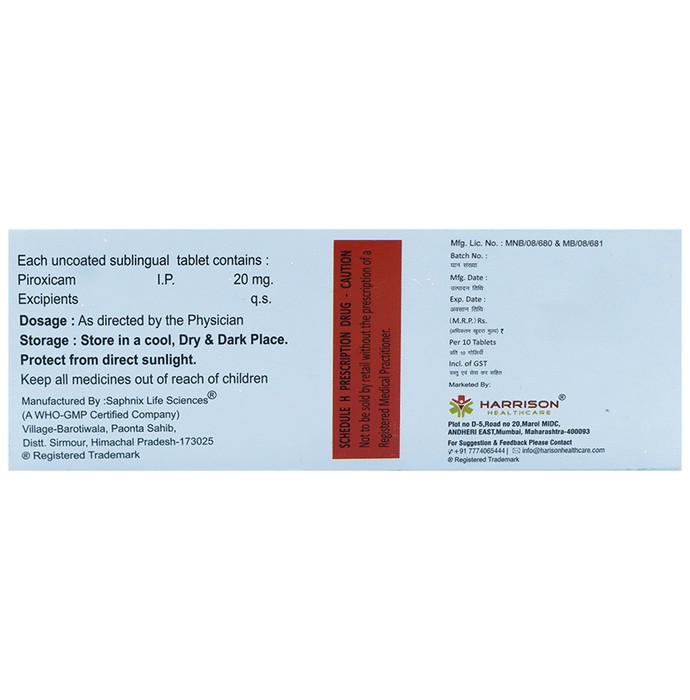
Pirogesic Sublingual tablet

Prescription Icon
Prescription Required

Marketer

Harrison Healthcare

Salt Composition

Piroxicam (20mg)

Overview Pirogesic Sublingual tablet

Ketorolac tromethamine sublingual tablets offer relief from moderate to severe pain. This medication is indicated for conditions such as osteoarthritis and rheumatoid arthritis, effectively managing joint and muscle pain and inflammation. Post-dental surgery pain may also be treated with this formulation. Administering this medication with food minimizes gastrointestinal upset. Dosage and treatment duration are determined by individual needs and response. Strictly adhere to the prescribed regimen for optimal therapeutic effects; exceeding the recommended dose or duration poses significant risks. Commonly reported side effects include mild nausea, vomiting, stomach pain, indigestion, and diarrhea. Persistent or worsening side effects necessitate immediate consultation with your physician, who can advise on potential mitigation strategies. Prior to initiating treatment, disclose any pre-existing conditions, including stomach ulcers, cardiovascular disease, hypertension, and hepatic or renal impairment. Complete disclosure of all other medications is crucial, as potential drug interactions may occur. Pregnant or breastfeeding individuals should seek medical counsel before using this medication.

Uses of Pirogesic Sublingual tablet

Analgesia

Major Benefits of Pirogesic Sublingual tablet:

Allow the Pirogesic Sublingual tablet to completely dissolve by positioning it either under your tongue or nestled between your cheek and gum. Avoid chewing, crushing, or swallowing the tablet whole. This medication should be administered with a meal.

Common Side effects of Pirogesic Sublingual tablet:

  • Vomiting
  • Stomach pain
  • Nausea
  • Headache
  • Dizziness

How to use Pirogesic Sublingual tablet:

Allow the Pirogesic Sublingual tablet to dissolve completely by positioning it either beneath your tongue or nestled against your gum and cheek. Avoid chewing, crushing, or ingesting the tablet whole. This medication should be administered with a meal.

How Pirogesic Sublingual tablet works:

Sublingual Pirogesic tablets are non-steroidal anti-inflammatory drugs (NSAIDs) that inhibit the production of inflammatory mediators, thus alleviating pain and swelling.

SAFETY ADVICE

AlcoholAlcoholUNSAFE

Avoid alcohol while taking Pirogesic Sublingual tablets; doing so is dangerous.

PregnancyPregnancyCONSULT YOUR DOCTOR

The use of Pirogesic Sublingual tablets during pregnancy may pose risks. While human data is scarce, animal research indicates potential harm to the unborn child. A physician will assess the potential benefits against any possible risks prior to prescription. Seek medical advice.

Breast feedingBreast feedingCONSULT YOUR DOCTOR

The use of Pirogesic Sublingual tablets while breastfeeding is likely inadvisable. Scant evidence from human studies indicates potential transfer of the medication into breast milk, posing a risk to the infant.

DrivingDrivingUNSAFE

Taking a Pirogesic Sublingual tablet may cause drowsiness, blurred vision, and dizziness, reducing alertness. Refrain from driving if you experience these effects.

KidneyKidneyCAUTION

Patients with severe kidney impairment should use Pirogesic Sublingual tablets cautiously, potentially requiring dosage modification. Physician consultation is advised.

LiverLiverCAUTION

Patients with hepatic impairment should use Pirogesic Sublingual tablets cautiously, potentially requiring dose modification. Physician consultation is advised.

What if you forget to take Pirogesic Sublingual tablet :

Should you forget a Pirogesic Sublingual tablet dose, administer it immediately. Nevertheless, if your next dose is imminent, omit the missed dose and resume your usual dosing regimen. Avoid taking a double dose.

Facts to Know About Pirogesic Sublingual tablet

LabelValue
Chemical Type Derivatives of Enolic Acids
Developing Habits No.
Treatment Category Pain Relief Medications

FAQs on Pirogesic Sublingual tablet

Pirogesic Sublingual tablets and diclofenac are both analgesics. Diclofenac, however, exhibits greater selectivity for the COX-2 enzyme than piroxicam, a non-selective COX inhibitor. This increased selectivity may reduce diclofenac's side effects relative to Pirogesic.
Pirogesic Sublingual tablets and naproxen, both non-selective COX inhibitors, offer comparable pain relief. However, naproxen demonstrates fewer gastric side effects than Pirogesic Sublingual tablets.
Meloxicam and Pirogesic Sublingual tablets are equally effective non-selective COX inhibitor pain relievers; however, meloxicam exhibits fewer acute gastric side effects.
Ketoprofen, whether in topical gel or oral form, and Pirogesic Sublingual tablets are both non-selective COX inhibitors, relieving pain by targeting this inflammation-causing enzyme. However, studies indicate ketoprofen topical gel surpasses Pirogesic Sublingual tablets in efficacy and exhibits excellent tolerability.
Pirogesic, a sublingual tablet, targets COX enzymes—responsible for inflammation and pain—while Tramadol is a habit-forming, narcotic-like analgesic.
Pirogesic Sublingual tablets and nimesulide are both analgesics. Unlike nimesulide, which selectively inhibits COX-2, Pirogesic Sublingual tablets non-selectively inhibit cyclooxygenase (COX), an enzyme involved in pain and inflammation. This selectivity makes nimesulide potentially less prone to side effects than piroxicam. Nimesulide is not indicated for children under 12.
Chikungunya typically doesn't lower platelet counts, but painkillers such as piroxicam increase bleeding risk. Therefore, avoid Pirogesic Sublingual tablets or any painkillers for fever with joint pain. Always consult your doctor before using Pirogesic Sublingual tablets.
Pirogesic Sublingual tablets and aspirin, while both COX (cyclooxygenase) inhibitors with anti-inflammatory and analgesic properties, are distinct medications.
Avoid concurrent use of Pirogesic sublingual tablets and dexamethasone due to their combined increased toxicity and heightened risk of gastrointestinal ulceration.
Yes, methocarbamol and Pirogesic Sublingual tablets may be used together; however, inform your doctor before starting either medication. No serious drug interactions are known.
While no known serious interactions exist between paracetamol and Pirogesic Sublingual tablets, it's advisable to consult your doctor before using them together.
Yes, Pirogesic Sublingual is a nonsteroidal anti-inflammatory drug (NSAID).
Pirogesic Sublingual tablets contain sulfur and may cause serious side effects, including severe skin reactions such as Stevens-Johnson syndrome, in susceptible individuals. Inform your doctor of any allergies.
Pirogesic Sublingual tablets are a pain reliever, not a blood thinner. They should be avoided by individuals with bleeding disorders.
Pirogesic Sublingual tablets are not muscle relaxants; they are analgesics that inhibit COX enzymes, thereby reducing inflammation and pain.
Pirogesic Sublingual tablets are non-narcotic analgesics. They reduce pain and inflammation by inhibiting COX enzymes, which are responsible for these processes.
Pirogesic Sublingual tablets do not treat hypertension. Using Pirogesic Sublingual tablets alongside antihypertensive medication reduces the effectiveness of the latter. Tell your doctor about any antihypertensive medications you're taking before using Pirogesic Sublingual tablets.
Don't take Pirogesic Sublingual tablets with Losartan. Combining them reduces Losartan's effectiveness, potentially causing your blood pressure medication to fail. Tell your doctor about all your blood pressure medications before starting Pirogesic Sublingual tablets.
Don't take Pirogesic Sublingual tablets if you're also taking lisinopril. Piroxicam reduces the effectiveness of lisinopril and other antihypertensive medications, potentially causing your blood pressure treatment to fail. Tell your doctor about all antihypertensive medications you're taking before starting Pirogesic Sublingual tablets.
Yes, Pirogesic Sublingual tablets can be taken with calcium channel blockers. Unlike other antihypertensive medications, calcium channel blockers' efficacy isn't diminished by NSAIDs (White, 2007).
Yes, Pirogesic Sublingual tablets can be used with tizanidine. Piroxicam, a pain reliever, and tizanidine, a muscle relaxant, are often combined to treat conditions such as back pain.
Pirogesic Sublingual tablets can be safely combined with beta-cyclodextrin. Studies indicate this combination accelerates piroxicam's onset and minimizes gastrointestinal adverse effects.
Yes, alternative pain medications exist. Your doctor will prescribe the appropriate pain relief based on your condition. Always consult your doctor before starting piroxicam or switching medications.
Piroxicam is contraindicated in patients with allergies, bleeding disorders, duodenal, gastric, or peptic ulcers, stomatitis, systemic lupus erythematosus (SLE), ulcerative colitis, upper gastrointestinal disease, late pregnancy, heart disease, liver impairment, or kidney impairment.
Pirogesic Sublingual tablets are not for treating allergies; they are an analgesic.
Pirogesic Sublingual tablets provide long-lasting pain relief. While a single daily dose may suffice for some, individual responses vary, and piroxicam's effectiveness generally increases with several weeks of use.
Pirogesic Sublingual tablets are a non-narcotic pain reliever and are not associated with causing hypertension.
While Pirogesic Sublingual tablets aren't approved for menstrual cramps, studies demonstrate piroxicam's significant effectiveness in relieving them.
While Pirogesic Sublingual tablets lack approval for migraine treatment, research demonstrates their effectiveness in substantially reducing pain from migraines without aura.
Yes, it may help reduce back pain. However, it's crucial to consult your doctor to determine the cause of your back pain before beginning any treatment. Do not self-treat with Pirogesic Sublingual tablets; back pain has various potential causes.
Pirogesic Sublingual tablets are effective in treating acute gout, as demonstrated by research.
Blood donation is permissible while taking Pirogesic Sublingual tablets; however, please inform your doctor beforehand.
In diabetic patients, Pirogesic Sublingual tablets should only be used under a doctor's supervision. Long-term use carries a significant risk of renal failure, a risk further amplified by the existing kidney complications often associated with diabetes. Therefore, combining Pirogesic (piroxicam) with diabetes substantially increases the likelihood of renal failure.
Pirogesic Sublingual tablets are contraindicated in individuals with impaired renal function due to the risk of renal papillary necrosis and other kidney damage associated with long-term NSAID use.
Pirogesic Sublingual tablets can cause serious, potentially fatal skin reactions, including exfoliative dermatitis, Stevens-Johnson syndrome (SJS), and toxic epidermal necrolysis (TEN). These reactions may develop unexpectedly. Stop taking the medication and contact your doctor immediately if you experience even a mild rash.
Pirogesic Sublingual tablets are contraindicated during pregnancy. Use may result in premature ductus arteriosus closure, potentially causing fetal heart failure and death.
Pirogesic Sublingual tablets are contraindicated for patients with active peptic ulcers due to their potential to cause gastric ulceration and bleeding.
Asthma sufferers may experience severe attacks when taking non-steroidal anti-inflammatory drugs (NSAIDs) such as aspirin, due to hypersensitivity. Always consult your doctor before using NSAIDs.
Yes, Pirogesic Sublingual tablets may cause temporary infertility. Piroxicam's mechanism of action can sometimes delay or prevent ovulation, leading to this reversible effect in some women. Talk to your doctor before using this medication.
Pirogesic Sublingual tablets are contraindicated with diuretics. In some patients, they diminish the sodium-excreting effects of furosemide and thiazides, likely by suppressing renal prostaglandin production.
Avoid using Pirogesic Sublingual tablets with lithium. This medication elevates plasma lithium levels and reduces renal lithium clearance by inhibiting renal prostaglandin synthesis. Always consult your doctor before taking Pirogesic Sublingual tablets.
Avoid Pirogesic Sublingual tablets if you're taking warfarin, as both increase bleeding risk. Disclose warfarin use to your doctor before taking Pirogesic. If both are used, close monitoring is essential.
Taking corticosteroids and anticoagulants raises your risk of gastric ulcers. Other factors increasing this risk include long-term medication use, alcohol consumption, smoking, and advanced age.
Individuals experiencing asthma, hives, or other allergic reactions to aspirin, other NSAIDs, or pain medication before or after cardiac bypass surgery.
Gastrointestinal upset, and in rare instances, severe gastrointestinal complications including ulcers and bleeding; serious skin reactions such as exfoliative dermatitis, Stevens-Johnson syndrome (SJS), and toxic epidermal necrolysis; liver failure; and kidney damage.
Pirogesic Sublingual tabl...
106
MRP 129
17% off
